


SOLAR CONVERSATIONS with… Marco F. Picasso
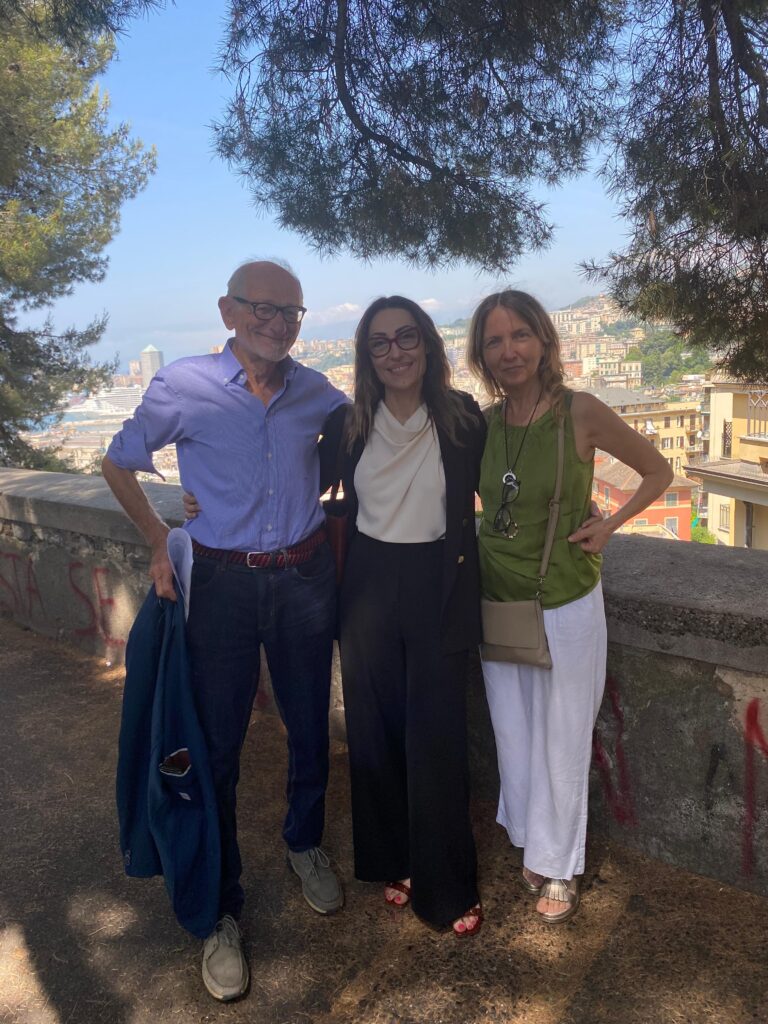
Marco Francesco Picasso, founder of METAPRINTART (https://www.metaprintart.info)
Chiara Prati, CEO&CSO PRATI Srl
Who said that the person who usually does the interviewing cannot be interviewed in turn? The roles are reversed, and the microphone passes to the other side.
In this “REVERSE INTERVIEW” – as it was nicknamed and long desired by Chiara Prati – we asked a few questions to Marco Picasso, to let him tell us something about himself, driven by great curiosity: to discover the secret of his “youthitude” (Marco, I invented that word just for you!).
Yes, because beyond his actual age, Marco Picasso is living proof that when you work with passion, work becomes art, since you pour your whole self into everything you do.
Fatigue is there, of course, but it is lightened by the love and enthusiasm that sustain the effort and many hours of travel! And Marco is a perfect example of this: always on the road visiting companies, often together with Roberto Mercati, the highway arrow.
Chiara and I have always wondered: “Where does Marco Picasso find all that energy?”
One thing that struck me about Marco is one of his “obsessions”, perhaps because it’s also mine.
When he needs to transform, in his own “Picassian” way, the press releases written for Prati, he needs to review all his drafts after a few days, to let the text rest.
There, I saw myself in that a lot.
Performance anxiety or perfectionist mania?
I wouldn’t know how to say, but it’s an anxiety I know well, since my time working at ItaliaImballaggio.
And yet, I believe this kind of anxiety is healthy and should be at the heart of everything we do: never being too sure of ourselves, always questioning what we do, trying to see things from other perspectives – not just our own.
Because writing (for those who take it seriously) implies an enormous sense of responsibility.
Beautiful things take time!
How many times have I written in the silence of the night, or stayed up late without looking at the clock just to finish an urgent piece. Boh!
So when I noticed that Marco also needed to reread an article after a few days to forget it, I saw myself again.
It’s not just a hunt for mistakes; I think it’s about re-seeking beauty (at least it is for me!). It’s the effort of telling a story while remaining detached from time, from oneself, and from the text.
Words remain, and if the message is well written, it not only reaches its destination but also comes back to us from other hearts. It’s pure happiness.
It’s like experiencing a blend of childlike joy (I’ve seen that in Marco too), enthusiasm for new things, the refusal to be satisfied with what we’re told or what we see (and that leads you to always ask your interlocutors questions).
To go beyond what we know, beyond what we see, to surpass ourselves, to never feel “arrived,” because every day there is still so much to learn – from life and from others.
I have no idea how many kilometres Marco Picasso has travelled across Italy to interview entrepreneurs, but for once, it was us who travelled those kilometres to meet him, on 25 June 2025, in his Liguria – and it was an enormous pleasure.
With you, there’s always something to learn! Thank you, Marco.
Concetta Daniela Binario
– – – – – – – – – – – – – – – – – – – – – – –
Chiara Prati: Marco, we’ve known each other for over 30 years now, and we can say we’ve “watched each other grow.”
Marco F. Picasso ‒ When we met it was 1999: you were very young, and I was, in fact, already grown up, but still young in graphic journalism.
Chiara Prati: What were the first steps that defined your educational journey?
‒ I believe that for each of us, the story of life and the way we work can be explained by Darwin’s theory of evolution: it’s the product of the interaction between internal stimuli, such as character, and external ones, such as environment. But, as happens in the evolution of species, chance also plays its part. For me, it was fundamental.
If I have to speak about my early years, my formative period, well, it was quite ordinary – neither good nor bad – typical of a boy raised in the middle-class city life.
Chiara Prati: But there’s nothing wrong with that…
‒ Of course. But in recent weeks, I’ve met some entrepreneurs from our world of printing and packaging, from whom I – and all of us – have much to learn. They come from the countryside, but their genius and vision drove them to go further, to make their dreams come true. I don’t feel special at all.
Another example I saw was your father, Pietro Prati. He told me his story, and I was deeply impressed: a young man who never felt sorry for himself – he had health issues at school – but who fought on, always looking for solutions rather than problems. In my opinion, he too was a genius and a visionary, driven by his desire to turn ideas into reality. And always with humility. Many episodes of his working life were marked by setbacks – sometimes internal, sometimes external – which he always overcame with perseverance. In this sense, I can say, with a small dose of pride, that I too have faced difficult times that helped shape me.
Chiara Prati: You put so much passion and enthusiasm into everything you do. I’m intrigued by your writing style – it’s different from that of your colleagues. How do you explain that?
‒ You see, I wasn’t born to be a writer. Writing became a necessity for me to express what was perhaps my original calling: curiosity, the desire to discover. Now you’ll laugh, but when I was a child we had a large 19th-century painting in our living room – a landscape with a mountain in the background. I would sit for hours staring at that painting, imagining what lay beyond the mountain. That was my nature, and it has remained so: I always want to find out what lies beyond – and I want to share it. I wanted to be an explorer, and maybe that’s why I graduated in geology: to see what’s not only beyond but also within.
Whenever I followed tunnel excavations for work, I felt completely at home. Not by chance, I wrote a novel featuring a tunnel as its protagonist, and the few people who read the draft were enthusiastic about it. I’d also add that this idea of “beyond” explains the “meta” in the name of my magazine.
Chiara Prati: So curiosity drives you. But your style is unique too…
‒ Yes, because I didn’t know how to write (laughs). So when I discovered that writing was my job, I started reading a lot – especially the great journalists of those years: Buzzati, Biagi, even Gianni Brera.
As I said, I’ve always wanted to know more. When companies invited us journalists to show a new product, I was never satisfied with what they told us – my colleagues teased me because my questions always delayed lunchtime…
But I’d like to go back to my experiences with Prati, because they’re quite meaningful.
September 1999 was a special moment in my life as a graphic industry journalist: Labelexpo in Chicago, which I attended with the Gipea group. And there I met Pietro Prati and a very young Chiara Prati. I went around the stands with you both, and he patiently explained the machines to me – perhaps he had more patience with me than with you!
He made me passionate about the complex world of labels – because printing them isn’t enough – helping me understand the importance of inspection and, today, embellishment.
Prati was a great teacher, because he never stopped there. He already had in mind new solutions to improve a sector that had only recently entered your world. He already sensed what could be developed. It’s not for me to talk about things you know better than I do, but when he spoke to me about booklet labels, I got excited: in just a few centimetres, you can tell an entire story (and I think this potential still hasn’t been fully understood or exploited, especially in the wine industry).
And then the labels – which someone once called “the festive dress of products” – had to become ever more beautiful, more complex, more refined. And so you invented embellishment.
In short, by following Prati’s progress, I’ve fulfilled my desire to discover.
Chiara Prati: But you still haven’t told me why you write your articles so differently from everyone else.
‒ Right, I got sidetracked… I’d say it all stems from Antonio Ghiorzo’s imperative that “articles must not be written with water but with blood.” True – but in my opinion, that’s not all.
For me, the answer is simple: people aren’t much inclined to read, but I’ve learned that if they find a technical article written almost like a story, they read it more willingly.
And, let’s be honest, I enjoy writing articles as if they were stories – lively, engaging ones.
Chiara Prati: Where does your passion for what you do come from?
‒ Because otherwise, I get bored.
Concetta Daniela Binario: We met when you were working with Antonio Ghiorzo… How did chance lead you to become self-employed and to the creation of MetaPrintArt?
‒ In my book “La Stampa è Bella” I talk about my various previous work experiences in industry. I made a virtue of necessity. In the first case, the company where I worked – a family business, unfortunately poorly managed – had to close in 1985.
Chance, and perhaps my meticulous way of working, led me to collaborate with Rassegna Grafica in 1990, and later to take charge of Graphicus in 2002. When the publisher of Graphicus ran into trouble and the company closed, I decided to found the first online magazine in our sector.
Concetta Daniela Binario: I found out you were in Cupra Montana. What were you doing there?
‒ I was in Umbria and the Marche for several work commitments – you can read about it in my “reso-cconto” (a rather unlikely neologism of mine mixing resoconto [report] and racconto [story]) called “Iridium Tour”, which came out of those three days – and I couldn’t miss a visit to the Museum of the Label in that charming little Marche town, home of Verdicchio wine.
I’ll tell you more: I want to involve companies in the sector, like yours, to organize events and special contests in addition to the national “Golden Label” award they already run. I’m in contact with the local council, and they seem open to the idea.
Concetta Daniela Binario: And finally, will you confess a few sins?
‒ I have to choose among many. I can’t stand know-it-alls – people who try to explain even what they don’t understand. I don’t hate ignorance itself, but arrogance. And I see far too much of it around. Maybe I even belong to that category myself, and so that’s probably my gravest sin.
Chiara Prati: After sharing all this journey with us… what will you do when you grow up?
‒ I don’t know whether in thirty years I’ll still be able to do something interesting – but I’ll try. There are still projects ahead!

